
STAGE 03 / 05
TRAPPED
The hardest prisons to escape are the ones built from parts of ourselves.

I paint over the wound
it returns
in another colour
I say “no”
and hear my father’s voice
inside my own mouth
I pull at the net
it tightens
perhaps the cage
has no lock
perhaps the key
must open the skin
Barbara Puto, 2026
When external expectations harden into an internal cage.
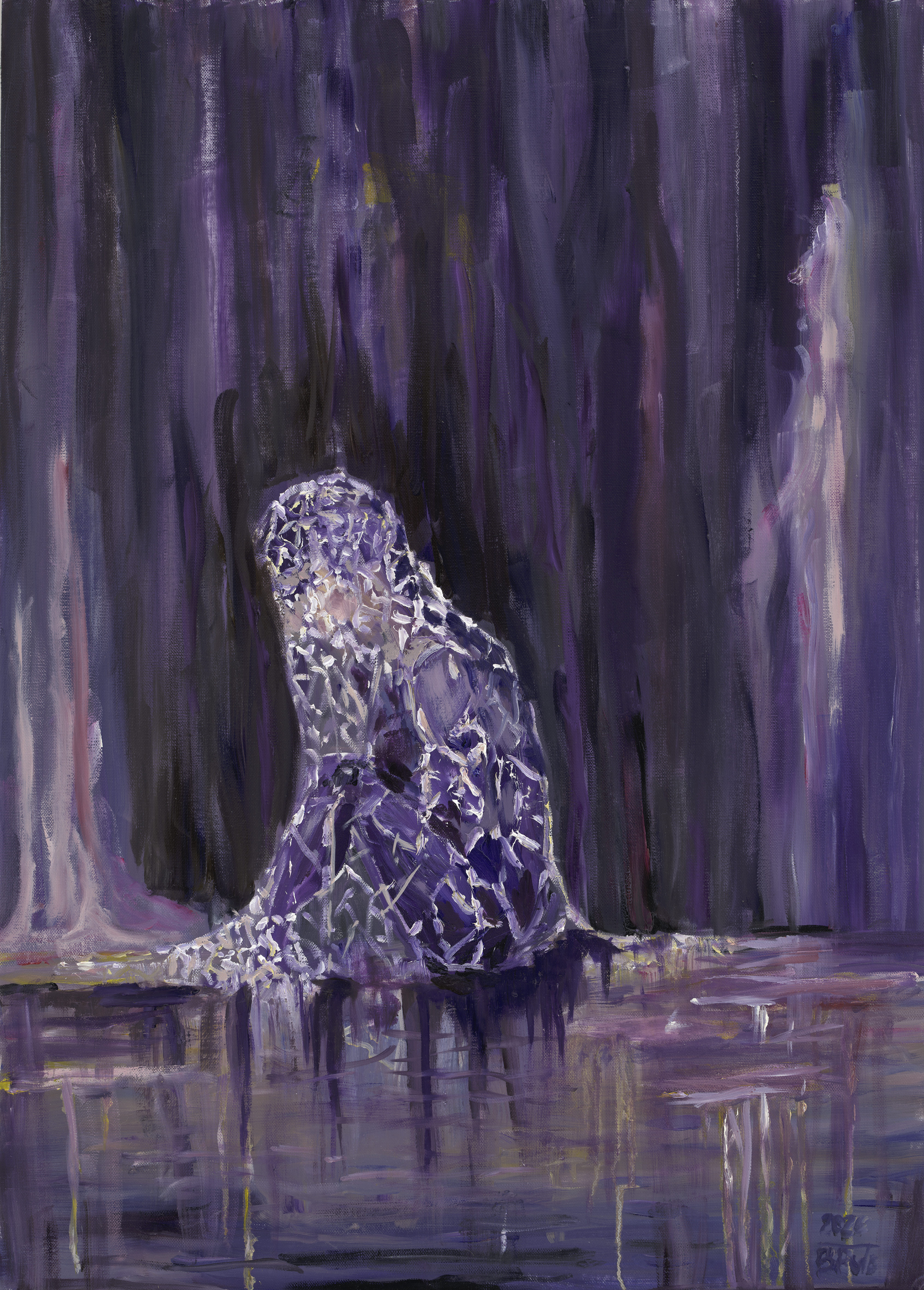
Trapped / Uwięziona
2026
70 × 50 cm
- Oil on cotton canvas mounted on a painting panel
- Michael Harding, Rembrandt, Schmincke and Van Gogh oil colours
- Michael Harding Oil Paint Medium No. 1
- Winsor & Newton Artists’ Retouching Varnish
- Tools: Traditional painting tools
- Software: None used in the creation of the artwork
Final protective varnish will be applied in February 2027, after sufficient curing time.
Trapped
The most dangerous prisons have no bars.
They are built when other people’s expectations, fears, patterns, prejudices, and dependencies stop sounding like voices from the outside and begin to speak in our own voice.
Trapped captures the moment when the boundary between a person and what confines them almost disappears. The net is no longer merely around the body. It has grown into it. It has become part of its surface, its memory, its way of being.
And that is precisely why it is so difficult to break free.
How do we free ourselves from something that has begun to look like part of who we are?
The figure does not fight. She is curled inward, withdrawn, almost enclosed within herself. The light is still there, but it is fading. It has not disappeared completely — it has been dimmed by the weight of a structure that is no longer carried around the body, but within it.
This is not a painting about an external oppressor.
It is a painting about the moment we discover that part of the cage has been built from what, for years, we have called “ourselves.”
The hardest prisons to escape are the ones built from parts of ourselves.
It has to be a small canvas. Or perhaps a thin painting panel? I don't want to give her too much space. I begin with a ballpoint pen. The figure folds in on herself almost immediately, and the net is already there. I am not looking for details yet. I am looking for a body that has almost forgotten how much space it needs.
01. NOT MUCH ROOM IN HERE.
I paint the human body quickly, almost schematically. The hard panel takes the paint without protest. There is stiffness, darkness, confinement. Should I make the figure larger? No. She stays small. She will grow when she is ready.
02. SHE STAYS SMALL.
I begin covering the body with the net. At first, it still looks like something external — something laid over her. I make it uneven, denser in some places, looser in others. It cannot become decorative. It has to start disturbing the body. I like the yellow drips. They are like islands of hope, dripping with impossibility.
03. HOPE HAS BAD TIMING.
I begin working on the background. It cannot be neutral. It has to create unease — darkness, tension, the feeling that something is about to happen. I give the lighter strokes a role, as if the makers of the net were watching over its integrity. The space around her should feel uncomfortable, almost pressing against the body.
04. THE SPACE HAS TO HURT A LITTLE.
The net wraps around the body, and the body begins to absorb it. The boundary between the figure and the structure becomes increasingly blurred. What began as an external limitation starts to become part of her own form.
05. SHE NEEDS MORE WEIGHT.
I make the final decisions. The net and the body are now almost inseparable. I mute the yellow drips. I liked them — perhaps too much. They carried too much light, too much hope for this moment. I need to anchor her, so I deepen the shadow where the body meets the ground. I also push the background further back, enlarging the sense of empty space around her. She is still trapped — but now the isolation feels larger..
06. HOPE HAS TO WAIT.