
RELEASING
The first crack in the cage begins with
a question: do I have to?
STAGE 04 / 05

something pinches me
pricks
leaves me no peace
this question:
do I have to?
I don't want to
exactly —
Barbara Puto, 2026
She is no longer asking what shaped her.
She is deciding what no longer gets to stay.
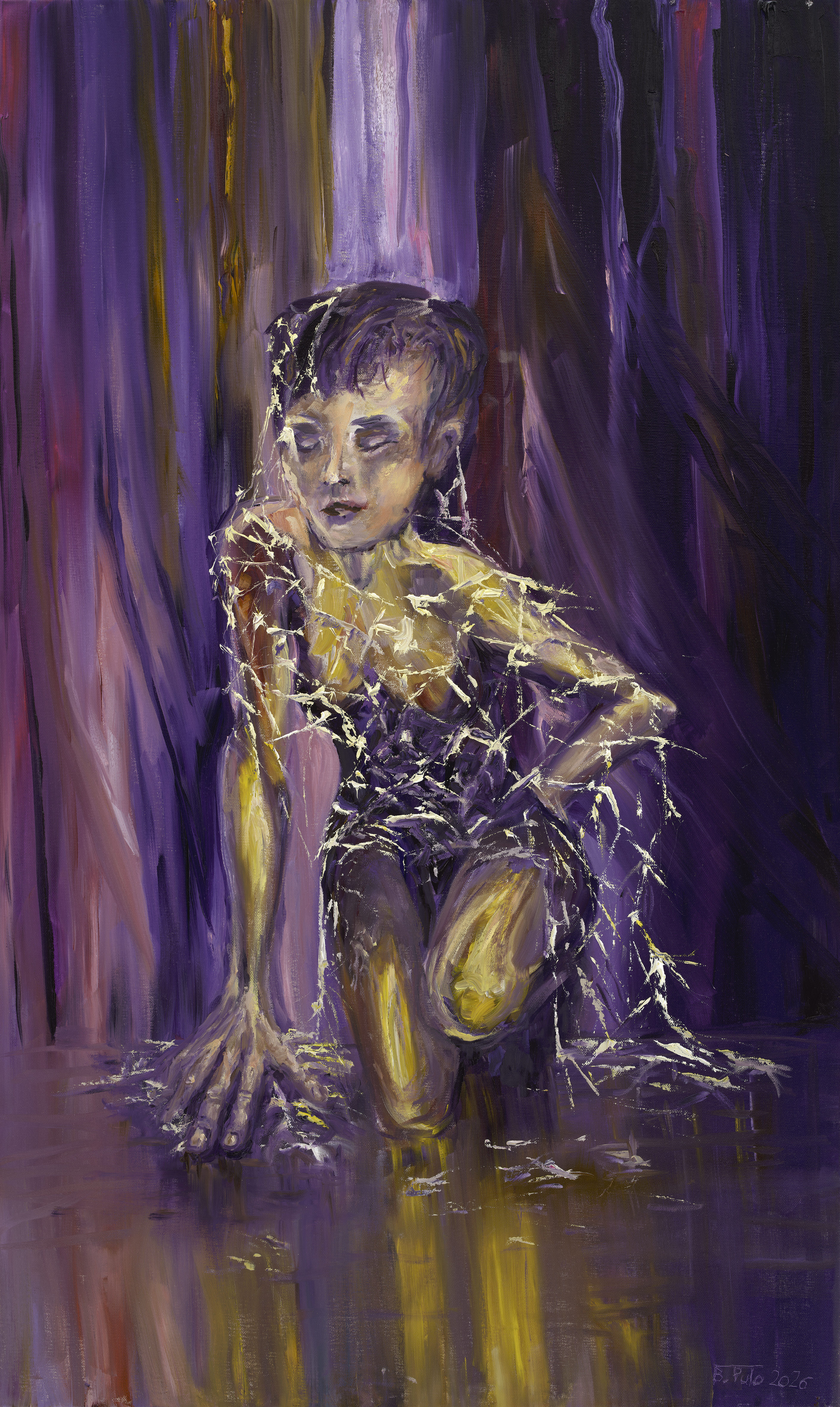
Releasing / Uwalnianie
2026
100 × 60 cm
- Oil on stretched cotton canvas
- Michael Harding, Rembrandt, Schmincke and Van Gogh oil colours
- Michael Harding Oil Paint Medium No. 1
- Winsor & Newton Artists’ Retouching Varnish
- Tools: Traditional painting tools
- Software: None used in the creation of the artwork
Final protective varnish will be applied in February 2027, after sufficient curing time.
Releasing
Freedom does not begin when the cage disappears.
It begins with doubt.
With a small, uncomfortable question directed at something we have obeyed for years without even realizing it:
Do I have to?
Releasing is about the moment when what once seemed unquestionable begins to lose its power. A belief. A fear. An expectation. A way of seeing ourselves. Something we have carried for so long that we have mistaken it for part of our identity.
Breaking away from it is not simple. If a limitation has become part of who we are, removing it can feel less like liberation and more like tearing away a piece of ourselves.
And yet, something has changed.
The figure is no longer only enduring her structure. She begins to separate herself from it. Not everything has fallen away. Not everything needs to. Freedom here is not an act of destruction, nor an attempt to erase the past.
It is an act of recognition.
This shaped me. This is part of my history. But this no longer has to decide who I become.
Perhaps freedom begins exactly there — not when nothing influences us, but when we finally reclaim the right to decide which influences we continue to carry.
I choose a canvas larger and slightly wider than the one I used for Trapped. Releasing needs more space. I want the figure to have room to move, to resist, and to begin separating herself from what confines her. Only then do I start with the imprimatura and the first drawing.
01. SHE NEEDS MORE ROOM.
I build the background around her. It is quiet, restrained, almost comfortable. I know it won't stay that way.
02. FOR NOW, EVERYTHING IS CALM.
I close her eyes and begin working more carefully on the hand. The hand matters. It cannot be passive or decorative — it has to carry agency. This is the hand that will tear the net.
03. THE HAND HAS TO KNOW WHAT TO DO.
No net yet. She isn’t finished. I put her next to the other paintings to see whether I am heading in the right direction. Sometimes the other paintings answer before I do.
04. LET’S SEE IF SHE FITS.
I add the net, tearing, fraying and blurring it in places. But the yellow is still too clean, and the face too radiant. The net has to merge into the body in some places and push its way out in others — almost like worms moving through the surface.
05. TOO CLEAN. I DON’T BELIEVE IT.
I dirty the yellow, take some of the smoothness out of the face and push the net deeper into the body. Some fragments remain on the surface; others seem to emerge from within. I want the effort to be visible. I keep working on the hand. The hand resists me. I paint it, wipe it away, and begin again. Apparently, it has its own opinion about how this painting should go. I could avoid the problem. Unfortunately, I know I would see it forever. So — one more time. Does it move me enough?
06. FREEDOM HAS A PRICE.