
STAGE 02 / 05
CONDITIONING
How much of who you are was decided before you could choose?

In Search
I experience.
Why do I cry when the light from the screen
becomes my glow?
I absorb the rough light
I search for my own god
in the cracks of everyday life.
I return the gaze.
How good it feels, at last,
to simply be.
Barbara Puto, 2018
Before you learn to choose, the world has already chosen so much for you.
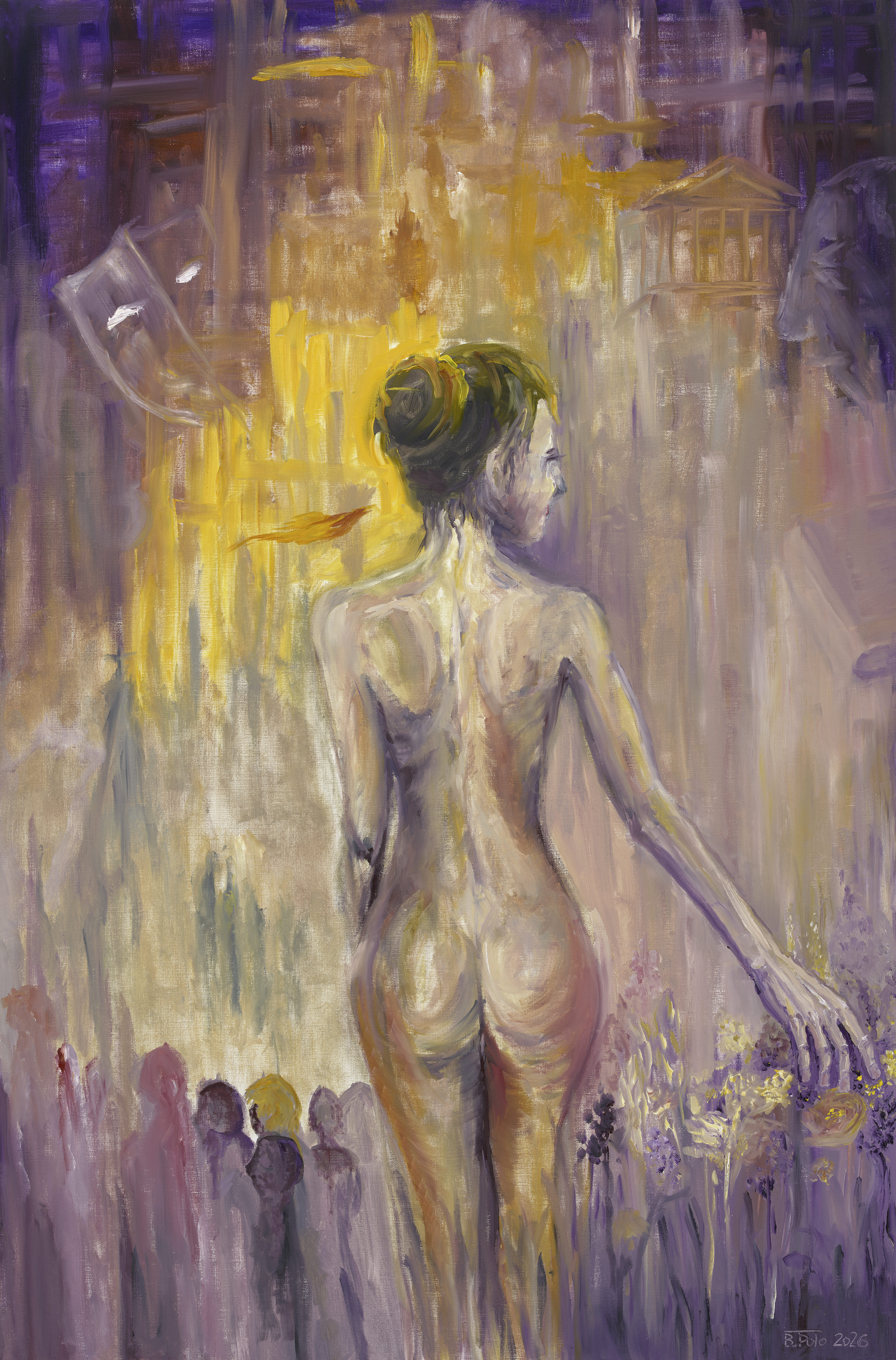
Conditioning / Uwarunkowania
2026
120 × 80 cm
- Oil on stretched linen canvas
- Michael Harding, Rembrandt, Schmincke and Van Gogh oil colours
- Michael Harding Oil Paint Medium No. 1
- Winsor & Newton Artists’ Retouching Varnish
- Tools: Traditional painting tools
- Software: None used in the creation of the artwork
Final protective varnish will be applied in February 2027, after sufficient curing time.
Conditioning
Conditioning expands the question introduced in Personality. We are shaped not only by the people we encounter, but also by the world into which we are born.
Culture, family, language, history, faith, nature, art, education, social expectations, and legal norms enter our lives long before we are able to decide whether we accept them. Some become sources of strength, sensitivity, and belonging. Others may become limitations. Most are neither simply good nor bad — they become part of the structure through which we understand ourselves and the world.
This is why the figure is not isolated from her surroundings. Elements of the external world enter her space and become intertwined with the body. The boundary between what comes from within and what has been absorbed from outside becomes increasingly difficult to define.
For me, nature and art are particularly important here. They do not merely surround us. They can alter our sensitivity, our imagination, and the way we experience reality. A film can make us cry. A landscape can remain within us for decades. A belief inherited in childhood can become either a source of meaning or something we later need to question.
Religious imagery appears here as a reference to faith as one of the cultural forces that may shape identity; it does not express or promote a particular religious belief or agenda.
Conditioning is not about rejecting these influences. Without them, there would be no self to liberate.
The painting asks a more difficult question:
How much of who you are was decided before you could choose?
I begin with a quick sketch of a nude figure. But this time, I am more interested in what will emerge around her. I want her to grow out of her environment — from people, nature, culture, faith, authorities and rules. A church silhouette, a theatrical mask, a school desk, the face of a sage, a legal paragraph and a red X suggesting prohibition appear. The church is not a statement about a particular religion, but a reference to faith as one of the cultural forces that may shape a person long before conscious choice becomes possible. I am building the world that, in a moment, will begin to build her.
01. BEFORE THE WORLD GETS IN
I add more signs: an institution, and I reinforce the red X suggesting prohibition. And suddenly I see the problem. Too many symbols. Not enough painting. The image is beginning to look like a rebus — something to be solved rather than experienced. That is not what I want.
02. THIS IS STARTING TO LOOK LIKE A REBUS
I begin to remove things. The school desk, the exclamation mark and the red X disappear. The desk is replaced by a barely visible book. I try adding a paintbrush. It does not work. That disappears too. The people, flowers and mask remain. Some traces I condemn to oblivion; others I allow only to be sensed.
03. NOT EVERYTHING HAS TO STAY
I mute the legal paragraph but allow it to show through. I no longer need so many signs. Colour can do more. Violets, ochres, pinks and the surrounding light enter directly into the body. What was around her becomes part of her.
04. LET COLOUR SPEAK NOW
The flowers could be taller. I decide against it — they would dominate the painting. It is not the flower that should reach the human being. She has to reach for the flower. I lower the hand. This small gesture on the canvas changes everything in terms of meaning: we do not passively accept everything that shapes us. Some things we reach for ourselves.
05. THE HAND HAS TO TOUCH
I refine the anatomy: the shoulder blades, the tension in the neck, the hair. And of course — the hand. The hand again. As usual, it is both a challenge and a torment. I keep correcting it anatomically until, at last, I stop seeing a painted hand and begin to see a pure gesture.
06. THE HAND. AGAIN.